How To Dance With a Partner: From Complexity to Simplicity, the Science of Leading and Following Workshop and Book Signing
With Andrew Weitzen
Contact us to schedule a workshop for your group.
People Do Not Know What They Are Doing
People do not know what is causing the woman to do what she does.
Weitzen's scientific analysis shows that all the woman's choreography is defined by three simple laws of Balance, Connection, and Direction.
In this workshop, you learn these subconscious rules that everyone is unknowningly following.
Upcoming Schedule for July and August
If you are in any of these areas, contact us to host a workshop at no charge.
Use this as a fundraiser for your group and to attract new people.
We recently got back from leading a two-hour workshop in Boston.
They raised $2,500 for their group with 50 attendees paying $50 each.
Approximate dates:
July 8 Korea
July 10 Japan
July 18 Korea
July 27 Maui
July 30 San Francisco
August 2 Gainesville
August 5 Orlando
August 9 Gainesville
Workshops are available for every kind of partner dancing including Argentine Tango, Ballroom, Contra, Hustle, Israeli, Salsa, Square, Swing, Waltz, West Coast, and others.
Workshops are available for all levels from people who have never danced before to advanced dancers and dance teachers.
Workshops are available both to dance groups and non-dance groups interested in learning to dance.
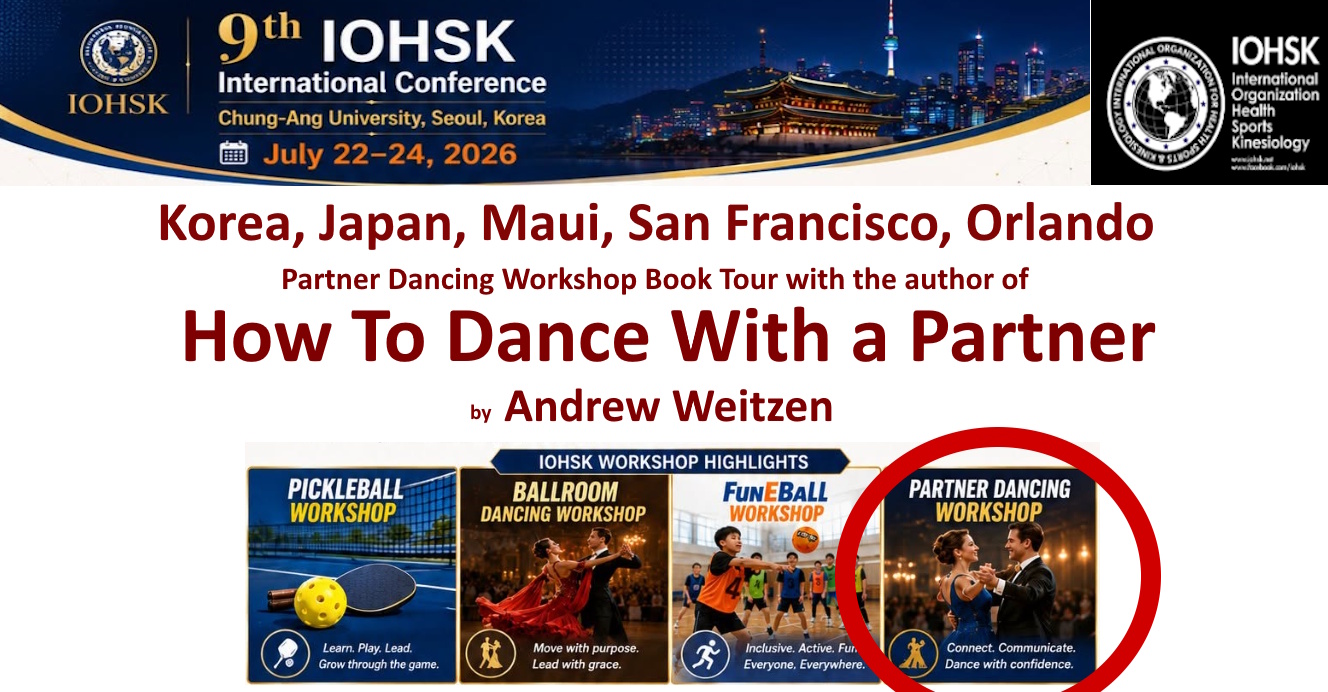
We will be presenting at the International Organziation for Health, Science and Kinesology (IOHSK) professional conference in Seoul in July
and attending the Korean-American Scientists and Engineers Association (KSEA) conference in Orlando in August.
Social Dancing
These workshops are for social dancing.
Social dancing puts the social nature of dancing first.
The goal is for two people to dance as one to the music.
In this workshop, you learn to speak with your partner through body language as easily as you speak in every day life.
Science-Based Theoretical Analysis of Leading and Following, From Complexity to Simplicity
The method for social dancing is the man leads and the woman follows.
The problem was until Weitzen's ABCDs™, no one knew precisely what leading and following means.
Men and women have been social dancing in Europe seemingly as far back as the eleventh century.
Since that time, the big question has been how does the woman know what to do?
For the last one thousand years, every dance teacher has answered this question, and they have all been wrong.
Some of what they say is good, some is bad, and sometimes they make up a story.
Neither the teachers nor the students know which is which.
Instruction is based on teachers' subjective experience.
The voice of authority prevails.
There is no theoretical analysis.
Some of the consequences are poor balance, unsafe behavior, anti-social behavior, conflict,
confusion, bad habits, and slow progress.
As one student quoted in Weitzen's book said, "Everyone is telling me something different.
How do I know what to do?"
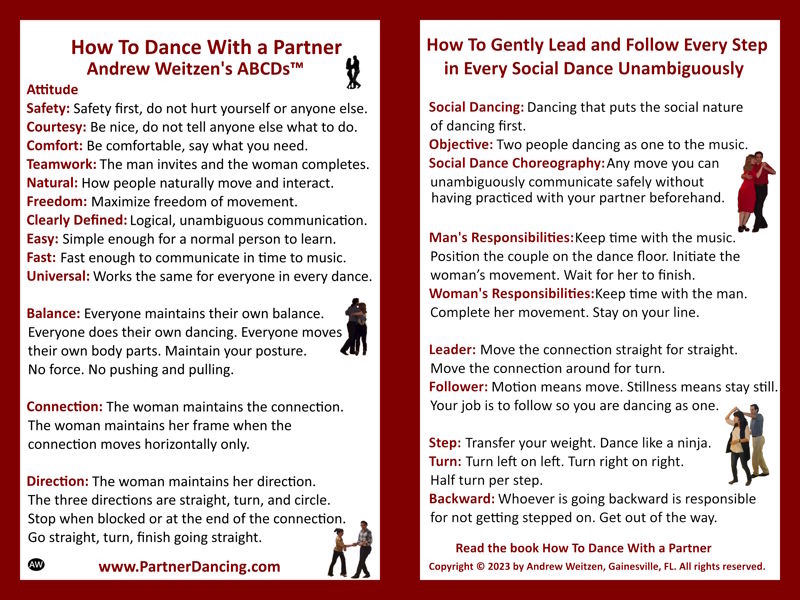
The solution is provided in the ABCDs.
This is a logically consistent and complete framework for social dancing with a partner,
documented with explicit actionable rules and objective measurable values.
The framework is so simple that the ABCDs fit on a single side of a postcard,
with definitions and tips on the other side.
Workshop Take Aways
In this fun workshop,
you learn the principles that apply to every social dance.
You learn to move as one with your partner.
You learn to improvise to the music.
Everyone learns to lead and follow the same way.
You learn to communicate once.
You apply the same principles in all your dancing.
You learn non-judgmental social dancing.
You learn to dance with everyone everywhere.
People become more respectful.
Your group becomes more socialable.
Everyone is able to have more fun.
You learn to dance without the use of force.
People dance safely.
Your experiences are more comfortable.
You learn to lead and follow unambiguously.
Your communication is clearly defined.
The rules are written down.
Everyone knows what to do without confusion.
You have a common language to talk about your dancing.
Teaching social dancing is easier.
Students get better faster.
Attendees receive a beautiful, laminated card with Andrew Weitzen's ABCDs of How To Dance With a Partner.
How Does the Woman Know What To Do?
Dancing with a partner is a math problem.
Andrew Weitzen first published the solution to this problem in 2007 in an ebook called Partnership Dancing.
Weitzen showed there are four elemental patterns that make up all the figures in social dancing.
Weitzen's three laws of Balance, Connection, and Direction, define the choreography of the woman.
Everyone is leading and following using these three laws without knowing what they are doing.
Weitzen presents the solution in the format of the ABCDs.
A for Attitude lists ten objective, measurable values for social dancing.
Weitzen's three laws of Balance, Connection, and Direction give you the clearly defined rules for leading and following.
What the Lady Does Is Simple in Theory but Challenging in Practice
In social dancing, we have two things, (1) the rules that define the choreography,
and (2) the techinque for moving.
Another way to say that is (1) what to do, and (2) how to do it.
When the lady is standing on one foot, she can step forward, backward, to the left, to the right,
on the four diagonals, or she can turn to the left or the right.
That gives her ten things she can do.
The man also has those ten things available to him giving 100 combinations on the first step.
Adding a second step gives 10,000 combinations without considering time, distance, or arm movement.
Therefore, there are too many possibilities for the lady to know what to do based on choreography.
Whether she knows or not, the lady is following simple rules that apply to her every movement.
Those rules are the three laws of Balance, Connection, and Direction.
These rules tell the lady what to do.
For the same reason, because there are too many combinations for the lady to know what comes next,
the lady's technique, that is how she moves, must always be the same for the specific movements the man asks her to do.
In this workshop you learn both what to do and how to do it.
Be the most knowledgeable teacher in your community.
Be the smartest dancer in your group.
The Author has Taught over 7,000 Dance Classes
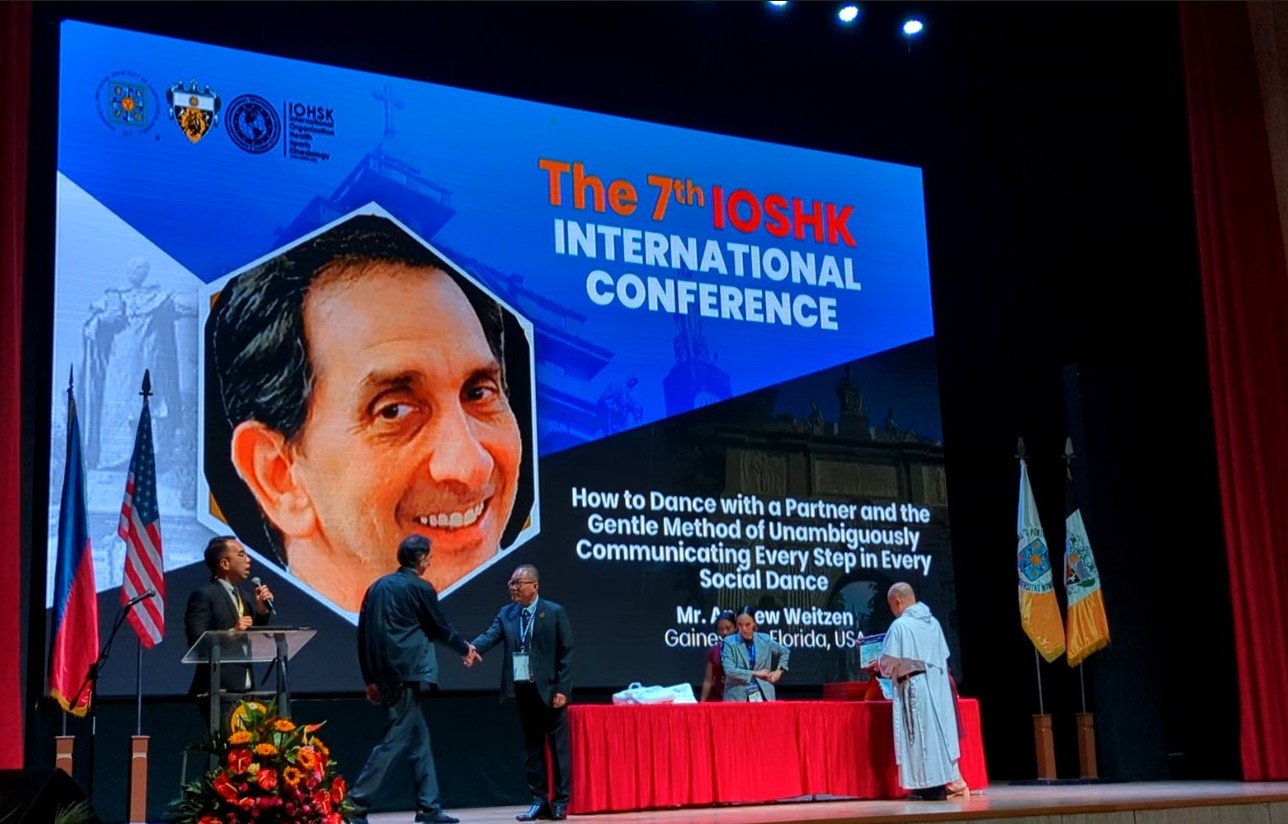
Author Receiving Award at the IOHSK International Organization for Health, Science, and Kinseology 2024 Conference in Manilla, Philippines
The author's books have been purchased in Australia, Canada, Germany, Italy, the United Kingdom, the United States, and elsewhere.
The author has given workshops in Canada, the Philippines, and around the United States at educational institutions including the University of Florida,
the University of Nevada Las Vegas, University of Texas RGV, University of Wisconsin LaCrosse
and for other groups in Alaska, Boston, Chicago, Colorado, Detroit, Ft. Lauderdale, Maine, Miami, South Texas, Virginia, and elsewhere.